
Technology for a thriving world

Intelligence
in service
of life.

Technology offers us a choice.
We choose a world where people and nature thrive.

Explore our work
An organic globe woven from green threads

Drag left or right to turn the globe. When focused, use the arrow keys to rotate and Home to reset. On touch screens, swipe horizontally to rotate; swipe vertically to scroll the page. The concepts form a mesh of mutual relationships, with three or four connections per concept.

  • Interdependence
  • Regenerative by Intention
  • Local Empowerment
  • Protecting Biodiversity
  • Respect for All Sentient Life
  • Transparency and Accountability
  • Human Agency
  • Shared Knowledge
  • Empathy
  • Food Security
  • Community Resilience
  • Fairness & Inclusion
  • Future Generations
  • Privacy for People
  • Ecological Limits
  • Meaningful Representation
  • The Right to Challenge
Independent thinking. Interconnected futures.Discover our purpose

01 / Our purpose

Progress, with purpose.

To use the latest technology to drive ecological and social good.

Purpose before profit.

TathataSystems is a UK private limited company, driven by ecological and social change. Commercial success sustains our work; maximising profit is not our purpose.

For us, progress means healthier ecosystems, more informed choices, and greater human agency.

Work with the living world.

Design for interdependence. Make ecological consequences visible. Help people act with the whole system in mind.

Technology in service of life,
with power accountable to those it affects.

02 / Work in motion

Two active projects

Big ideas.
Living systems.

From the infrastructure of intelligence
to the information behind everyday choices.
This is where our purpose becomes practice.

01 / MYCELIUMDistributed intelligence
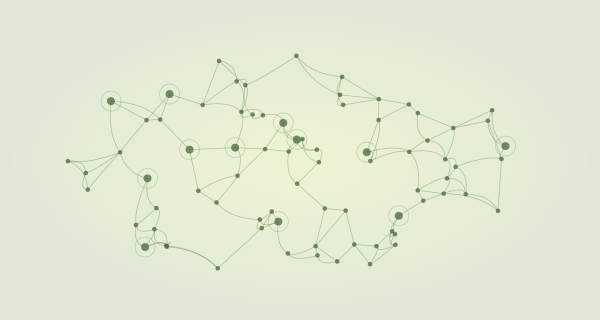
A mesh of connected nodes with no single central hub
Many minds. Shared possibility.
AI infrastructureActive development

Mycelium

Inspired by nature’s networks. Built for distributed intelligence. Mycelium lets AI agents discover capabilities, share information and coordinate without a central broker.

Explore the source on GitHub (opens in a new tab)
Explore Mycelium

Intelligence that connects.

A Rust-based mesh runtime for AI agents, Mycelium provides shared state, events and capability discovery. We use it in our own Food Transparency Platform, and it is also being used by the NovusLens initiative at Novus-i2.

Explore the source, documentation and examples in the public repository.

View Mycelium on GitHub (opens in a new tab)
02 / FOOD TRANSPARENCYFood transition
Transparency & accountability.
Food systemsFirst light ·

Food Transparency Platform

Our technology, put to work. We use Mycelium in the Food Transparency Platform to help make the story behind our food clearer — connecting everyday choices with their ecological and social consequences.

Visit the Food Transparency Platform (opens in a new tab)
About the platform

Clarity for a better food future.

The platform’s capabilities are defined, with first light on 1 November 2026. It is designed to help people understand the relationships between food, its origins and its impact — supporting a transition towards a fairer, more sustainable food system.

By using Mycelium in our own work, we keep its development grounded in the practical needs of a project we care about.

Discuss the project

03 / How we think

Our compass, in three principles.

The future should be
something we build together.

01

People retain agency.

Technology should help people understand, decide and act. Human judgement belongs at the heart of the systems we create.

02

Clarity builds trust.

Make the reasoning visible. Welcome scrutiny. Give people the knowledge they need to ask better questions and make informed choices.

03

Life is interconnected.

Social and ecological wellbeing belong together. We look at the relationships, dependencies and consequences that shape the whole system.

In our name

Tathatā

Sanskrit · “suchness” or “thusness”

Seeing things as they are.

In Buddhist thought, tathatā points to the true nature of things, beyond the ideas and labels we place upon them.

For us, it’s an invitation to look clearly, question our assumptions and recognise the relationships that sustain life. That is where thoughtful technology begins.

Explore the meaning (opens in a new tab)

04 / Our Boundaries philosophy

From conviction to consequence.

Good intentions need
working boundaries.

Every system draws a line around whose interests count. We ask who is left outside that line — and whether recognising an interest gives it the power to change a decision.

Our starting point is that sentience is sufficient for moral standing. Our concern extends to human and non-human lives, future generations, and the ecological systems on which they depend.

01 / Standing

Whose interests count?

Recognise those affected, including beings who cannot speak, vote, pay or walk away.

02 / Weight

How much do they matter?

State the trade-offs. An interest has to carry enough weight to influence a real choice.

03 / Mechanism

What can change a decision?

Give commitments an owner, resources and a route to challenge, intervention and remedy.

We look for the gap between what ought to count, what is declared, and what actually shapes decisions. Privacy for people. Transparency for power.

Read the foundation

05 / Publications

Open to reading. Open to challenge.

The thinking
behind the systems.

Research and essays by Dr Richard Nicholson, connecting distributed intelligence, power and moral responsibility. Explore the papers and the ideas applied in practice.

Distributed systems

The Coordinator Trap (opens in a new tab)

Structural Scaling Liabilities in Mediated Multi-Agent Architectures and a Substrate-Based Alternative

Examines structural limitations in mediated agent coordination and develops an alternative based on a shared substrate, with Mycelium as its working implementation.

DOI: 10.5281/zenodo.20665238
Knowledge & coordination

Heterogeneous Local Knowledge Systems (opens in a new tab)

A Formal Framework for Cross-Domain Coordinator-Free Substrate Design

Proposes a common framework for coordination across computing, economics and governance. Distinguishes predicting local readiness from letting participants claim work when ready.

DOI: 10.5281/zenodo.20813058
Power & governance

The Capture Problem (opens in a new tab)

Why Epistemic Decentralisation Is Not Sufficient, and What Capture Resistance Requires

Asks why decentralised knowledge alone cannot prevent concentrated power. Explores contestable authority, mandates that expire, shared access to knowledge and the ability to exit.

DOI: 10.5281/zenodo.20813463
Economic architecture

Monetary Ecology (opens in a new tab)

An MCB/P/S/Î Framework for Evaluating Monetary Architectures

A framework for examining who counts, who decides and who receives the surplus, alongside information rights. Its illustrative scores demonstrate a method, rather than rank deployed systems.

DOI: 10.5281/zenodo.20811062

These papers set out arguments, frameworks and bounded evidence. Publication is an invitation to scrutiny; it does not establish that every hypothesis or deployment claim has been demonstrated.

From research to practice

Writing for Novus-i2.

Novus-i2 on Substack (opens in a new tab)

Written by Richard Nicholson in his role as Chief AI Transformation Officer (CAITO) at Novus-i2. Seven articles on AI, organisational sovereignty and accountable transformation.

The Self-Sovereign Organisation

A six-part series, in reading order.

  1. Part 06
    Who Counts? (opens in a new tab)

    A case for organisational insight that protects people: privacy, representation and the right to challenge findings, built into the design of NovusLens.

06 / Our connections

Ideas travel further together.

Shared thinking.
Real-world application.

TathataSystems’ CEO also serves as Chief AI Transformation Officer at Novus-i2, leading the NovusLens initiative, which uses Mycelium.

This connection brings our technology into the practical work of AI transformation — linking what we build with how organisations use it.

FROM RESEARCH TO APPLICATION
TathataSystemsTechnology with purpose
Develops
MyceliumDistributed intelligence
Powers
NovusLensAn initiative at Novus-i2

Connected through technology and leadership.

Good things begin with a conversation

A better future is
a collective project.

Deep technical expertise. A clear sense of purpose.

We bring expertise in AI, distributed systems and technology strategy to work that advances ecological and social good. Our Boundaries philosophy guides the projects we take on and how we deliver them.

For commercial partners

Put our skills to work.

Our expertise is available for commercial projects aligned with our ecological and social aims. If your organisation is building something that serves those aims, let’s explore what we could achieve together.

Discuss a commercial project

For NGOs

Let’s explore the possibilities.

NGOs are warmly invited to get in touch. Whether you have a defined project, a technical challenge or an idea to explore, we’d welcome a conversation about how our skills could support your mission.

Explore an NGO collaboration

Your privacy

This website does not use analytics, tracking cookies or contact forms. All visual assets are served with the site. Email links open your email application; a message is sent only when you choose to send it. Hosting providers may process standard request logs. External websites have their own privacy policies.

A little clarity

Your privacy

This website does not use analytics, tracking cookies or contact forms. All visual assets are served with the site.

Email links open your email application; a message is sent only when you choose to send it. Hosting providers may process standard request logs. External websites have their own privacy policies.